
A Real-World Guide from a UK DJ with 25+ Years of Experience
How to Become a Festival DJ
I’m Jerry Frempong, a UK-based DJ with over twenty-five years behind the decks, and I can tell you this with complete honesty: becoming a festival DJ is not about luck, and it’s definitely not about shortcuts. It’s about commitment, musical identity, resilience, and learning how the industry truly works from the inside out. If you’re searching for how to become a festival DJ and actually play big stages in front of real crowds, this guide is written for you, not for algorithms, not for hype, but for DJs who genuinely want to build a long-lasting career.
When people imagine festival DJs, they picture massive crowds, main stage moments, and international bookings. What they don’t see is the years of preparation, networking, rejection, and refinement that happen long before that first festival slot ever appears. Festival DJing is the result of consistent work, not a single viral moment.
Understanding What a Festival DJ Really Is
A festival DJ is not simply someone who can mix tracks smoothly. Festival DJs are performers, curators, crowd readers, and brand builders. When you play a festival, you’re not just entertaining people, you’re representing a sound, a vibe, and often a genre. Promoters book festival DJs who can control energy on large systems, adapt to unpredictable crowds, and deliver memorable moments.
If your goal is to become a festival DJ, you must stop thinking like a bedroom DJ and start thinking like a professional artist. Festival DJ sets demand confidence, musical direction, and technical reliability. One mistake on a big stage can follow you for years, so preparation is everything.
Developing the Skills Required to Become a Festival DJ
Before you think about festivals, you must master DJ fundamentals. Beatmatching, phrasing, EQ control, gain staging, and transitions must be second nature. Festival stages are not forgiving environments. Loud systems expose weak mixing instantly, and poor track selection can empty a crowd faster than silence.
Beyond technical ability, learning how to read large crowds is essential. Playing to a thousand people is completely different from playing to fifty in a club. Festival DJ sets often happen during daylight, early evenings, or transitional time slots, which means you must understand how to build energy without relying on darkness or peak-hour aggression.
A festival DJ also understands sound systems. Large rigs behave differently, and knowing how bass travels outdoors will massively improve your set delivery. This knowledge separates amateurs from professionals faster than any fancy trick.
Choosing Your Sound and DJ Identity
One of the biggest mistakes aspiring festival DJs make is trying to sound like everyone else. Festivals book DJs with clear musical identities. Promoters want artists, not playlists. If you want to become a festival DJ, you must define your sound early and stick to it long enough to be recognised for it.
Ask yourself what genre genuinely excites you. House, techno, drum and bass, afro house, amapiano, bassline, or electronic crossover styles all have festival demand, but only when delivered with authenticity. Your DJ identity should influence your track selection, branding, visuals, and online presence.
Your sound is your signature. Over time, people should recognise your sets within minutes. That recognition is what leads to repeat bookings and bigger festival opportunities.
Building a DJ Brand That Festival Promoters Trust
Festival promoters don’t just book DJs who can mix, they book DJs who look reliable, professional, and marketable. Your DJ brand starts with consistency. Your name, artwork, imagery, and tone should align across all platforms.
Social media is important, but not in the way most DJs think. It’s not about chasing followers, it’s about showing evidence that people enjoy your sets. Videos of crowd reactions, live clips, and event footage build trust. Promoters want proof that you can hold a crowd and elevate their event.
A professional press kit is still vital. Include a strong biography, high-quality photos, performance history, and links to live mixes. If you want to become a festival DJ, you must present yourself like one before you ever play a festival.
Producing Music to Increase Festival DJ Bookings
In today’s industry, producing your own music dramatically increases your chances of becoming a festival DJ. Original tracks give promoters something tangible to associate with your name. Even a handful of well-received releases can change your booking trajectory overnight.
Festival DJs often build their reputation through tracks that resonate on dancefloors long before they reach big stages. Focus on quality, not quantity. One strong release supported by the right DJs can open doors faster than ten average tracks.
Producing music also strengthens your DJ sets. Playing your own tracks creates unique moments that audiences remember. Festivals value originality, and original music gives you leverage.
Playing Clubs Before Playing Festivals
Every successful festival DJ you admire spent years playing clubs, bars, and underground events. Clubs are where you learn discipline, adaptability, and endurance. They teach you how to handle difficult crowds, technical issues, and unpredictable environments.
If you’re serious about becoming a festival DJ, treat every club set as training. Learn how to warm up, close nights, and support headliners. Promoters notice DJs who understand structure and respect line-ups.
Club residencies are particularly powerful. They show reliability, consistency, and commitment. Many festival bookers scout club talent long before they ever look at social media metrics.
Networking the Right Way in the DJ Industry
Networking is often misunderstood. It’s not about begging for bookings or sending unsolicited messages. Real networking happens organically through genuine relationships. Show up, support others, and be present in your local scene.
Speak to promoters respectfully. Thank them after gigs. Share their events. Be professional in communication. These small actions build long-term trust. The DJ industry is smaller than it looks, and reputations travel fast.
If you want to become a festival DJ, understand that promoters talk to each other. Be known as reliable, punctual, and easy to work with, and opportunities will follow naturally.
Getting Your First Festival DJ Booking
Your first festival DJ booking is rarely glamorous. It might be an early slot on a small stage, or a local festival with a modest crowd. That first booking matters more than you realise. How you perform, how you behave, and how you support the event can determine whether you’re invited back.
Treat every festival slot like a headline performance. Prepare meticulously. Arrive early. Respect the crew. Deliver a set that fits the time and stage. Festivals remember DJs who exceed expectations, especially when there’s nothing to gain immediately.
Once you’ve played one festival, you’re no longer untested. That single booking becomes leverage for future opportunities.
Scaling Up to Larger Festivals
Progression in festival DJing is gradual. One festival leads to another, then slightly bigger stages, then better time slots. Patience is essential. Rushing your development often leads to burnout or stalled careers.
As your profile grows, invest in better visuals, improved production quality, and stronger branding. Festival organisers appreciate DJs who evolve. Keep refining your sound while staying true to your identity.
Touring festivals internationally becomes possible once you’ve proven consistency at home. Many UK festival DJs build strong European followings before expanding globally.
Staying Relevant as a Festival DJ
Longevity is the real measure of success. Trends change, genres evolve, and technology shifts, but strong DJs adapt without losing their essence. Continue learning. Stay curious. Listen widely. Collaborate with younger artists and remain open to new sounds.
Health and mindset also matter. Festival schedules can be intense. Look after your hearing, manage your energy, and protect your passion. Burnout ends more DJ careers than lack of talent.
After twenty-five years in this industry, I can confidently say that becoming a festival DJ is one of the most rewarding journeys you can take, but only if you respect the craft and the culture.
Final Thoughts on How to Become a Festival DJ
If you’re serious about how to become a festival DJ, understand that it’s a marathon, not a sprint. Master your skills, define your sound, build relationships, and show up consistently. There are no shortcuts that last, but there is a clear path for those willing to walk it.
Stay patient, stay focused, and most importantly, stay authentic. The festival circuit doesn’t need copies, it needs voices. If you commit fully, keep learning, and believe in your sound, there’s absolutely a place for you on those stages.
If you have ever dreamed of standing behind the decks in front of thousands of people, feeling the energy of a massive crowd as the bass drops and lights explode across the stage, this is your moment.
The world of Festival EDM DJing is one of the most exciting and rewarding careers in modern music culture. From playing underground events to performing at major festivals, successful EDM DJs combine creativity, technical skill, branding, marketing, and business knowledge to build unforgettable careers.
The problem is that most beginners have no idea where to start.
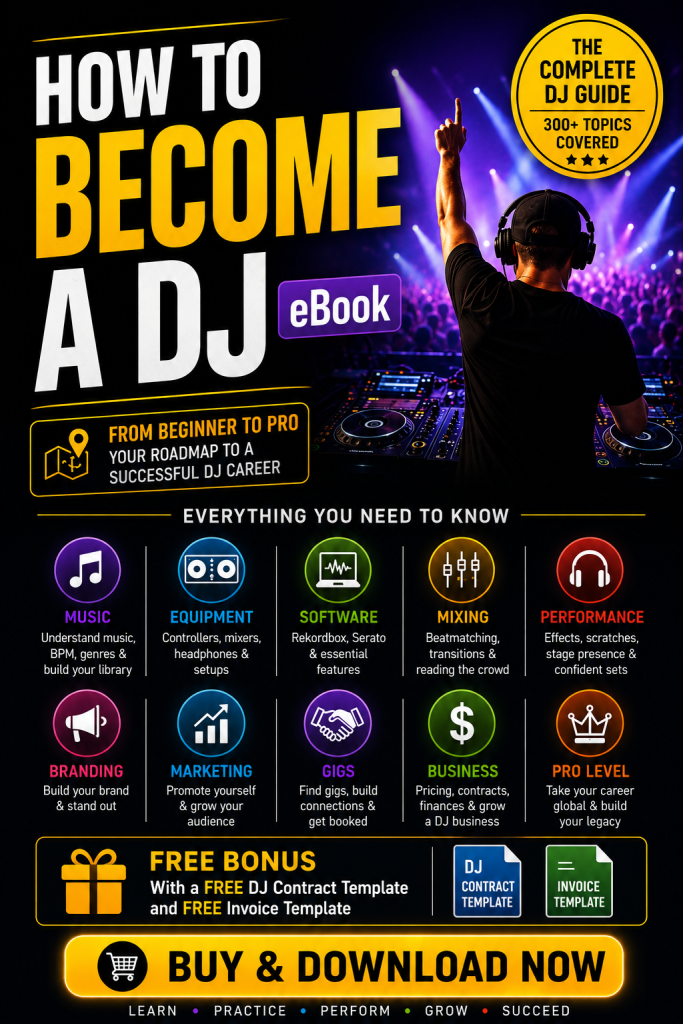
That is exactly why the “How to Become a DJ” eBook was created.
This complete beginner to professional roadmap gives you everything you need to start your DJ journey and grow into a confident Festival EDM DJ. Whether you want to perform at clubs, beach festivals, warehouse raves, private events, or major electronic dance music festivals, this guide gives you the exact foundation needed to move forward with clarity and confidence.
Unlike random YouTube tutorials and confusing online advice, this eBook is structured step by step so you can learn the right skills in the right order.
You will discover how professional DJs build careers, grow audiences, market themselves online, secure bookings, improve their performances, and create a long term income through DJing.
This powerful eBook contains 14 in depth chapters covering every major area of becoming a successful DJ.
Learn the foundations of DJ culture, the mindset needed to succeed, and how the modern EDM industry works.
Develop a strong understanding of BPM, phrasing, song structure, energy control, transitions, and how to read a dancefloor like a professional Festival EDM DJ.
Understand DJ controllers, mixers, CDJs, turntables, headphones, speakers, audio interfaces, and what equipment beginners should buy first.
Learn the most popular DJ software platforms including Rekordbox, Serato DJ, Traktor, and Virtual DJ.
Master beatmatching, EQ mixing, blending tracks, transitions, looping, cue points, effects, and creating smooth professional DJ sets.
Take your performances to another level with scratching techniques, crowd interaction, stage presence, live remixing, and performance confidence.
Learn how to build your DJ name, personal brand, logo, visual identity, online image, and artist profile.
Discover powerful DJ marketing strategies using Instagram, TikTok, YouTube, Facebook, SEO, playlists, DJ mixes, blogging, and music promotion.
Learn how to approach promoters, clubs, bars, lounges, festivals, and event organisers to secure your first paid DJ bookings.
Understand DJ pricing, invoices, contracts, taxes, budgeting, equipment investment, and building a sustainable income stream.
Discover how EDM producers create original music and why producing tracks can massively accelerate your Festival DJ career.
Take your abilities further with harmonic mixing, live mashups, creative transitions, performance workflows, and advanced festival techniques.
Learn how professional DJs manage stress, travel, fitness, sleep, hearing protection, and maintaining balance in a demanding music industry.
Discover how to turn DJing into a full time career with management, PR, sponsorships, networking, international branding, and long term career growth.
This is not just another generic DJ guide.
This eBook is specifically designed for ambitious DJs who want to perform electronic dance music at clubs, festivals, and live events.
Whether your passion is:
…this guide gives you the blueprint to build your skills and career properly.
You will learn how successful DJs think, prepare sets, promote themselves online, build fanbases, and become memorable performers.
Perfect for beginners with no previous experience.
Follow a structured path from learning basic mixing to building a professional DJ career.
Understand how professional DJs secure bookings, grow audiences, and market themselves effectively.
Avoid expensive mistakes when buying DJ equipment and software.
Gain the skills and mindset needed to perform confidently in front of crowds.
Learn modern promotion strategies that help DJs get noticed online.
Understand the business side of DJing including branding, finance, contracts, networking, and growth.
Learn techniques used by professional Festival EDM DJs to control energy and engage audiences.
When you purchase this eBook today, you will also receive:
Protect yourself professionally with a ready to use DJ contract template designed for gigs, events, and private bookings.
Send professional invoices to clients and event organisers with a simple editable invoice template.
These valuable bonuses help you operate like a professional from day one.
This eBook is ideal for:
Whether you are starting from scratch or looking to level up your existing DJ career, this guide gives you practical knowledge you can apply immediately.
The global electronic dance music industry continues to grow every year.
Festivals, clubs, live streams, online music platforms, and social media have created more opportunities than ever before for talented DJs.
Today, DJs can build audiences worldwide through:
The DJs who succeed are not always the most talented.
They are often the most consistent, prepared, professional, and knowledgeable.
This eBook helps you become one of them.
Your future as a Festival EDM DJ starts with one decision.
The earlier you begin learning the correct skills, building your brand, and understanding the industry, the faster you can progress toward real opportunities and professional bookings.
Stop guessing.
Stop wasting time watching random tutorials without direction.
Get the complete roadmap that teaches you exactly how to become a successful Festival EDM DJ from beginner to professional.
Click here to buy and download the “How to Become a DJ” eBook now